
"The best time to start strength training was ten years ago. The second best time is right now — and the science says the first thirty days are the most valuable thirty days you'll ever have. Most people waste them entirely." - Sorin
Here's something the fitness industry rarely leads with: beginners build muscle faster than anyone else. Not slightly faster - significantly faster. A 2026 preprint from Roberts et al. published on SportRxiv measured muscle size gains across 78 weeks of training and found the hypertrophy curve is front-loaded, steep, and time-limited. Your body has never experienced this kind of stimulus before. It responds aggressively. And then, as you get fitter, the response slows down. The window is real, it's measurable, and most beginners spend it doing the wrong things - or nothing at all.
This guide is built on one principle: minimum effective dose. As a certified 10X Fitness coach, I've spent years studying what actually moves the needle for people who are starting from zero. The answer is not complicated. Three full-body sessions per week. Four movement patterns. Bodyweight or minimal equipment. No gym membership required. That's it. Everything else is detail.
Why the First 30 Days Are the Most Important of Your Training Life
The Roberts et al. 2026 preprint tracked muscle hypertrophy across a large dataset and found that muscle size increases approximately 5.6% at 6 weeks, 7.0% at 10 weeks, and 7.5% at 12 weeks for beginners. The growth curve then flattens significantly as training age increases. Separate research from Franco et al. (Journal of Strength and Conditioning Research) found untrained men added 1.0–1.5 kg of lean mass in just 8 weeks of structured training.
What drives this acceleration? Two mechanisms work in your favour as a beginner that advanced lifters can no longer access.
First: neural adaptation. When you've never trained before, a significant portion of early strength gains comes from your nervous system learning to recruit muscle fibres more efficiently. Your muscles exist — your brain just hasn't learned to use them fully yet. This neural rewiring happens fast, and the strength gains in the first weeks often outpace the actual muscle growth underneath.
Second: muscle protein synthesis (MPS) duration. Research published in the American Journal of Physiology shows that after a resistance training session, MPS stays elevated for up to 48 hours in beginners. In experienced lifters, that window shrinks to around 16–24 hours. Every workout triggers a longer, more sustained muscle-building response in someone who's new to training. The same stimulus produces more output.
This window is not permanent. The research is clear that after the first several months of consistent training, the response normalises. You can still build muscle - you always can - but never again at the rate available to you right now, if you're starting from scratch. That's the urgency the fitness industry rarely communicates honestly.
The Four Movement Patterns That Cover Everything
Strength training looks complicated from the outside. It isn't. Every movement the human body makes in a strength context can be classified into four fundamental patterns. Master these four, and you've trained every major muscle group in your body — no machines, no isolation exercises, no gym required.
1. The Squat
Squatting trains your quadriceps, glutes, and core. As a beginner, the bodyweight squat and the goblet squat (with a dumbbell or weight held at your chest) are the entry points. The movement pattern is simple: hips back and down, knees tracking over your toes, chest up. It's the most natural loaded movement the human body makes, and the strength gains here transfer directly to everything from climbing stairs to picking up children.
2. The Hinge
Hinging trains your hamstrings, glutes, and lower back — the posterior chain, which is chronically underdeveloped in most people who sit at desks. The glute bridge and the Romanian deadlift are the beginner entry points. The movement is a bend at the hips with a neutral spine, not a squat. Learning the difference between a squat and a hinge is one of the most important early milestones in beginner training.
3. The Push
Pushing movements divide into horizontal (push-ups, bench press) and vertical (overhead press). As a beginner without equipment, the push-up is the foundation. If you can't yet do a standard push-up with good form, the incline push-up — hands elevated on a chair, counter, or step — is an identical movement at a reduced load. Progress to flat push-ups, then to adding a loaded variation when you're ready.
4. The Pull
Pulling is the most neglected pattern in beginner programs, and the one with the highest payoff. Pull movements train your back and biceps — the muscles that counterbalance all the pushing and sitting-forward posture most people accumulate. The best bodyweight pull for a beginner with no equipment is the Australian row (also called an inverted row) under a table. A pull-up bar in a doorframe opens up band-assisted pull-ups, which are worth adding as soon as possible.
One exercise from each pattern. Three sets each. That's a full-body workout. The simplicity is not a limitation — it's the architecture of the minimum effective dose approach that the 10X Fitness method is built on.
What Equipment You Actually Need (and What's Optional)
The honest answer is: you need less than any fitness retailer will tell you. Here's what the first phase of a no-gym strength program actually requires, in order of priority.
Your bodyweight — free, always available. The squat, hinge, push, and pull patterns can all be performed with bodyweight alone. Push-ups, glute bridges, bodyweight squats, and Australian rows under a table require nothing. This is a fully functional strength training programme. The limitation is progressive overload — eventually you need a way to increase resistance, but that point is weeks away for most beginners.
A resistance band set (£15–£30 / $20–$40) — the highest-value beginner purchase. Resistance bands change the game for home training. They add resistance to squats and hinges, make band-assisted pull-ups accessible immediately, and provide the pulling resistance that's otherwise hard to generate without a bar. A set of three to five bands at different tensions covers every training need for the first three to six months. This is the one piece of equipment I'd recommend to every beginner before anything else.
A pull-up bar ($25–$40) — the second best purchase. A doorframe pull-up bar gives you vertical pulling (the king of upper back development) and horizontal pushing (ring push-ups or gymnastic ring progressions if you go further). Combined with resistance bands for assistance, it makes a complete pulling programme possible from day one, even if you can't yet do a single unassisted pull-up.
Adjustable dumbbells — when you're ready to load. After six to eight weeks of consistent bodyweight training, adding a dumbbell for goblet squats, Romanian deadlifts, and overhead press accelerates everything. Adjustable dumbbell sets are more space-efficient than fixed-weight pairs and cover a much wider range as your strength grows.
What you don't need: a gym membership, a bench, a barbell, a squat rack, or any machine. These are tools for intermediate and advanced lifters who've already exhausted simpler progressions. As a beginner, they add complexity without adding proportionate benefit.
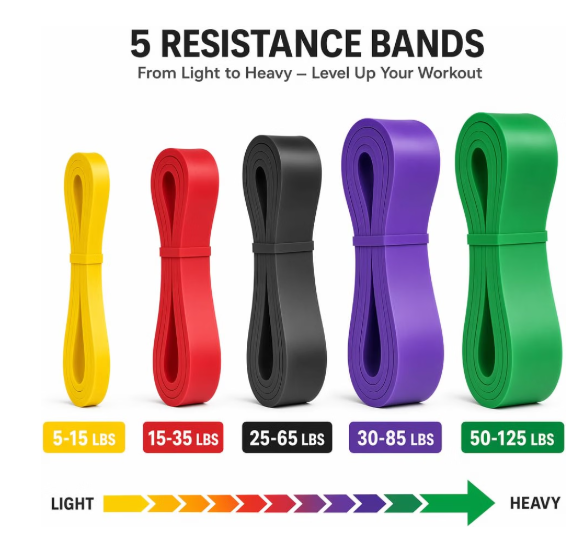
This is an affiliate link. I earn a commission if you purchase — at no extra cost to you.
Your First 30-Day Programme — Three Days a Week, Full Body
This is the programme. It's built on the research-backed principle of three full-body sessions per week with at least one rest day between sessions. Every session hits all four movement patterns. Volume starts low and increases every two weeks. The goal for the first thirty days is not maximum intensity — it's consistent repetition of correct movement patterns while your nervous system adapts.
Sessions per week: 3 (e.g. Monday / Wednesday / Friday, or Tuesday / Thursday / Saturday)
Rest between sessions: At least one full day
Session duration: 30–40 minutes
Warm-up: 5 minutes of light movement — arm circles, leg swings, hip rotations, ten bodyweight squats
Weeks 1–2: Foundation
Three sets of 8–10 reps per exercise. Rest 60–90 seconds between sets. Focus entirely on form — slow the movements down, feel the target muscle working.
- Squat: Bodyweight squat or goblet squat (hold a water bottle, bag, or any weight)
- Hinge: Glute bridge (lying on your back, feet flat, drive hips up)
- Push: Incline push-up (hands on a chair or counter) or standard push-up
- Pull: Australian row under a table, or band pull-apart if you have bands
Weeks 3–4: Progressive Overload
Three sets of 10–12 reps. Add difficulty to any exercise where the previous version feels easy — not heavier for the sake of it, but heavier because the form is solid and the stimulus has weakened.
- Squat: Add a resistance band above the knees, or hold a heavier object for a goblet squat
- Hinge: Progress to single-leg glute bridge, or Romanian deadlift with dumbbells if you have them
- Push: Progress to standard push-ups, or add a pause at the bottom
- Pull: Band-assisted pull-ups (if you have a pull-up bar), or add a resistance band to your row
Progressive overload — the principle of gradually increasing the demand on your muscles — is what separates training from exercising. If the workout feels the same at week four as it did at week one, you haven't progressed. Add resistance, add reps, slow the tempo, reduce rest time, or progress to a harder variation. The specific method matters less than the direction: harder than last time.
The Three Mistakes That Kill Beginner Progress
1. Training too hard too soon. The beginner window is valuable because your body responds to low stimulus levels. You do not need to be crushed by a workout to trigger adaptation. Training to failure, excessive soreness, and missed sessions from burnout are the enemy of progress, not the sign of it. The goal in the first month is showing up three times a week consistently — that alone puts you ahead of the majority.
2. Skipping the pull pattern. Every beginner programme that isn't purpose-designed tends to overload pushing (push-ups, bench press) and neglect pulling. This imbalance creates postural problems, shoulder instability, and an aesthetic that looks unfinished. For every pushing exercise in your programme, you need at least one pulling exercise. The back is the foundation of a strong body — it's just harder to see in the mirror, which is why beginners skip it.
3. Programme-hopping. The fitness internet is full of programmes that promise faster results. Switching programmes every two weeks is one of the most common beginner errors, and it's particularly damaging because it interrupts the neural adaptation process just as it's starting to compound. Pick a structure and stay with it for at least eight weeks. Consistency over eight weeks beats variety over eight weeks, every time.
Nutrition: What Matters for a Beginner Specifically
This is not a nutrition post, and you don't need a perfect diet to build strength as a beginner. But three fundamentals apply regardless of whatever else you're doing.
Protein: Muscle protein synthesis needs amino acids. Aim for a minimum of 0.7–1g of protein per pound of bodyweight (or 1.6–2.2g per kg). This doesn't require a complicated meal plan — it requires being deliberate about including a protein source in every meal. Eggs, chicken, fish, Greek yogurt, legumes, protein powder. The specific source matters far less than the total.
Calories: You cannot build muscle in a prolonged caloric deficit. As a beginner, you have a small window where you can build muscle and lose fat simultaneously — this is known as body recomposition and it's genuinely more accessible for untrained individuals than for anyone else. But if fat loss is not the goal, being at or slightly above maintenance calories accelerates the process considerably.
Sleep: Growth hormone is primarily released during deep sleep. Muscle protein synthesis continues for hours after training — but it needs sleep to fully express itself. Seven to nine hours is not a lifestyle recommendation; it's a performance variable.
If you want a structured approach to the eating side of this, the post on intermittent fasting for weight loss covers how a simple eating window can remove decision fatigue without requiring a full diet overhaul.
Tracking Your Progress: What to Measure
The scale is a poor measure of strength training progress, especially in the first few weeks when you may gain lean mass and lose fat simultaneously — causing the number to stay flat even as your body is changing significantly. The scale lies. Use better metrics.
What to track instead:
- Performance: How many reps at what weight for each exercise. This is the clearest signal that the programme is working.
- Photos: Every two weeks, same lighting and angle. The camera doesn't lie the way the scale does.
- Energy levels and sleep quality: Training that is calibrated correctly makes you feel better within two weeks, not worse. If you're consistently exhausted, the volume or frequency is too high.
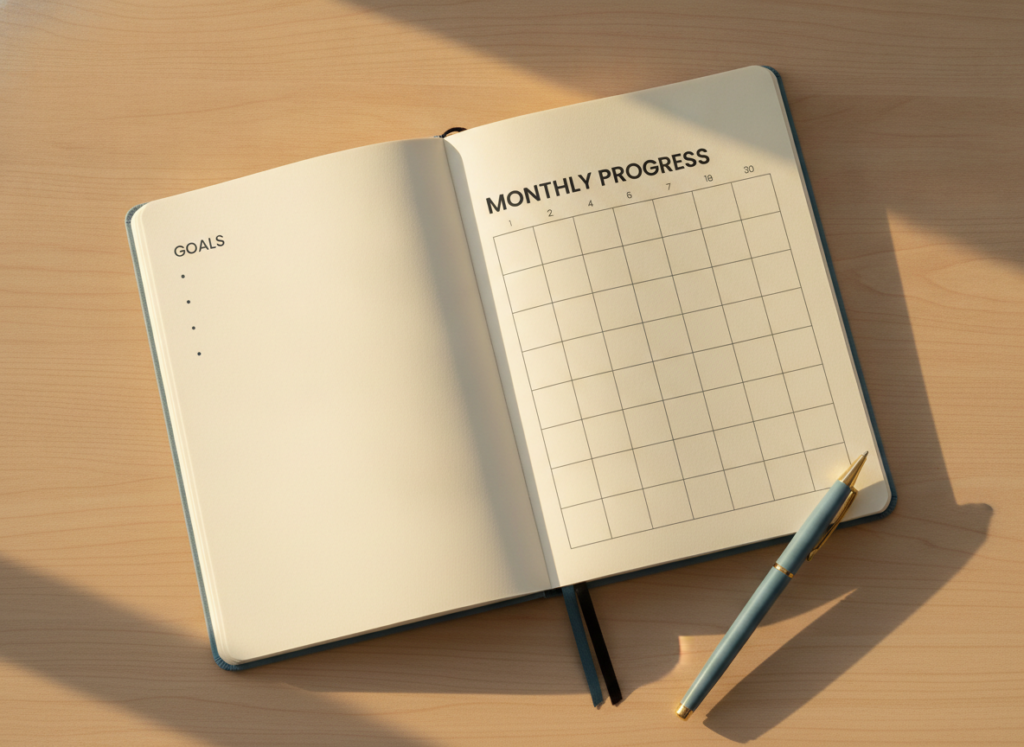
- A workout log: This is non-negotiable. You cannot apply progressive overload if you don't know what you did last session. Even a cheap notebook works. Write down: date, exercise, sets, reps, weight (or variation). That's it.
What Comes After the First 30 Days
After a month of consistent training, three things will have happened. Your movement patterns will be established. Your nervous system will have adapted significantly — the strength gains in this period will feel disproportionately large compared to what you'll see in later months. And you'll have built the most valuable asset in any training programme: the habit of showing up.
The next phase is adding load. This is when adjustable dumbbells or a resistance band set becomes important — the bodyweight progressions that served you well in month one eventually plateau, and you need external resistance to keep the progressive overload principle working. It's also the phase where the 30-day structure challenge can help build the habit layer on top of the physical foundation you've just laid.
The beginner window is real. The research confirms it. The only question is whether you use it.
Get Weekly Coaching Insights
One email every week — nutrition insights, fat loss strategies and performance tips from the coaching journal to your inbox. No filler. Just what works.
Sorin is a certified performance coach based in Canada. He writes about nutrition, fat loss and the unconscious patterns that make dietary change stick — or cause it to rebound.


Where are you starting from — absolute zero, or coming back after a break?
Tell me what's been the biggest barrier to starting a strength training routine — time, equipment, not knowing where to begin, or something else. I want to know what's actually getting in the way. Leave a comment below — I read every one and respond personally.