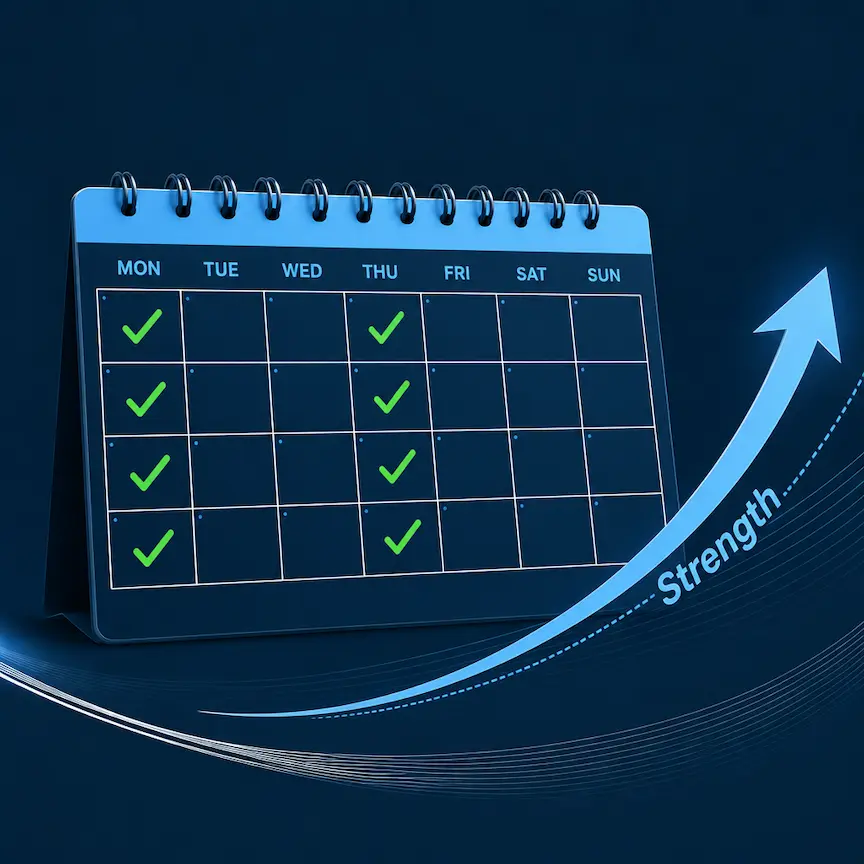
"I trained less than I ever had in my life and got stronger than I ever had. Here's exactly why that's not a coincidence." — Sorin
Two 15-minute sessions a week. No gym membership. No six-day program. And the best strength results I've ever produced — measured in a way that doesn't lie.
If that sounds like a shortcut, it isn't. It's what happens when you stop confusing volume with intensity — and start asking a different question entirely. Not how much can I do, but what is the minimum stimulus my body actually needs to adapt.
The answer, backed by peer-reviewed research and confirmed by my own measured results, is probably far less than you've been told.
What the Research Actually Says About Training Frequency
A 2026 meta-regression published in Sports Medicine by researchers at Florida Atlantic University's Muscle Physiology Laboratory examined the relationship between weekly training volume, frequency, and both muscle hypertrophy and strength gains across a large body of resistance training literature.
The central finding: weekly volume is the primary driver of muscle growth — not training frequency. Spreading identical volume across two sessions versus four sessions produces similar muscular adaptations. How many days you train matters far less than whether the quality and intensity of those sessions are high enough to trigger a genuine adaptation response.
This isn't an isolated finding. Multiple independent lines of research point to the same conclusion:
- A meta-analysis in the Journal of Human Kinetics found that two sessions per week produced 80–90% of the strength gains of more frequent programs — with significantly less accumulated fatigue
- Research comparing two versus four weekly sessions in trained men found no significant difference in muscle hypertrophy when total volume was matched between groups
- The 2026 ACSM guidelines explicitly recommend training all major muscle groups at least two days per week — not as a floor to eventually exceed, but as a legitimate, evidence-backed protocol in its own right
Two days per week isn't the consolation prize for people who can't commit to more. It is a legitimate, research-supported training frequency that produces real results — when intensity is high enough.
The Variable Almost Everyone Ignores: Intensity
Here's where most people misread this. They hear "two sessions a week is enough" and picture two comfortable, moderate-effort sessions. That's not what this means.
The reason two high-intensity sessions produce results comparable to four moderate-intensity ones is that intensity — not volume — is the primary trigger for muscular adaptation. When you train at genuine maximum effort, you recruit more motor units, create more mechanical tension in the muscle fibers, and generate a stronger hormonal response than any amount of moderate-intensity volume can replicate.
Research on high-intensity versus high-volume training consistently shows the same pattern: intensity-matched sessions require longer recovery windows, but the adaptation signal they generate is proportionally stronger. Your body doesn't need more sessions to grow. It needs more recovery time between genuinely hard ones.
This is the entire premise behind the 10X Fitness Method — and why it works. Two full-body sessions per week, each lasting approximately 15 minutes, each taken to genuine muscular failure on compound movements. The brevity is the point. If you can comfortably train for an hour, you weren't training hard enough.
The Number That Doesn't Lie: Power-to-Weight Ratio
I want to give you a concrete result rather than just citing research papers.
When I committed fully to two 15-minute sessions per week following the 10X protocol — and stopped supplementing with anything else on top of it — my power-to-weight ratio moved from 2.8 to 5.9 in eight weeks. More than double. Not a rounding error. A measurable, tested result.
I wasn't training more. I was training with enough intensity that each session actually counted as a genuine stimulus rather than just movement. That's the difference.
It also isn't as surprising as it might sound. Trainees who switch from high-volume moderate-intensity programs to low-frequency high-intensity protocols consistently report disproportionate strength gains in the first 8–12 weeks, for one simple reason: they're finally creating a strong enough signal for the body to actually respond to.
Recovery Is Where the Adaptation Actually Happens
Here's what nobody explains clearly about high-intensity training: the adaptation doesn't happen during the session — it happens in the 48 to 72 hours after it.
When you train to genuine muscular failure, you create micro-damage in the muscle fibers that requires real recovery time to repair and rebuild stronger. Train again before that process is complete and you're not building on progress — you're interrupting it.
This is why six-day programs with moderate intensity often produce surprisingly poor results for natural trainees: cumulative fatigue prevents the recovery that makes the training worthwhile in the first place. You're doing laps around a parking lot and calling it progress.
Two sessions per week — with 72 hours between them — gives the body exactly the window it needs to complete the repair cycle and come back stronger before the next stimulus arrives. That spacing isn't laziness. It's the protocol.
What "Two Workouts a Week" Actually Looks Like
To be clear about what this protocol requires — because "two short sessions" sounds easier than it is:
- Session duration: 15–20 minutes maximum. If you're going longer, the intensity isn't high enough
- Exercise selection: Compound movements only — pull-up, push-up to failure, bodyweight squat or equivalent. No isolation exercises
- Intensity: Every set taken to genuine muscular failure — the point where you cannot complete another clean repetition
- Frequency: Two sessions per week, never on consecutive days. Monday/Thursday or Tuesday/Friday are both solid splits
- Progress measurement: Power-to-weight ratio, not scale weight or mirror assessment
That last point matters. Scale weight is one of the worst possible metrics for measuring what this protocol produces — you're simultaneously losing fat and gaining lean muscle, and the scale will sometimes move in directions that look like failure when you're actually succeeding. I covered this in detail in Why the Scale Lies — And What to Measure Instead. Track power-to-weight instead. It doesn't lie.
And speaking of training for real-world results — not just aesthetics — let's talk about what functional strength actually means when it counts.
This is an affiliate link. I earn a commission if you purchase — at no extra cost to you.
The Objection I Hear Every Time
"But I've seen people who train six days a week and look incredible."
Yes. And almost all of them share one or more of the following: they're genetically predisposed to respond well to volume training, they've been training for a decade or more and have built the adaptation base to handle that frequency, or they're using pharmacological assistance that dramatically accelerates recovery between sessions.
For a natural trainee with a regular life, a job, a family, and a finite amount of recovery capacity — the six-day-a-week model is not just unnecessary, it's actively counterproductive for most people most of the time. You're not failing because you can't commit to daily training. You're succeeding by choosing a protocol that actually matches how your body recovers.
Why This Only Works Inside a Bigger System
Training frequency doesn't exist in isolation. The reason two sessions a week produces results is that the sessions sit inside a broader system where recovery, sleep, nutrition and structure are all working together rather than against each other.
If you're doing two hard sessions a week but sleeping five hours a night, eating ultra-processed food throughout the day and running on chronic stress — the protocol won't deliver. The session is the stimulus. Everything else is the recovery environment that determines whether the adaptation actually happens.
This is the core of what this blog is built around. Focus, fitness and fat loss aren't three separate topics — they're three inputs into the same system. Optimize one without the others and you're leaving most of the result on the table.
If you want to understand how eating structure fits into this — specifically why eating less isn't the same as eating right — the intermittent fasting post covers the nutrition side of the same minimum-effective-dose principle. And if you want the full framework for building all three pillars into a working daily structure, the 30-Day Structure Challenge is the most practical place to start.
The Simplest Possible Summary
Two workouts a week is not a compromise. It is not a starting point you graduate from once you get serious. It is a legitimate, peer-reviewed, coach-tested protocol that produces real strength gains when applied correctly — specifically when intensity is high enough that the body has no choice but to adapt.
The fitness industry benefits from selling you more — more memberships, more sessions, more equipment, more complexity. The research doesn't support more. It supports harder.
Train less. Train harder. Recover fully. Repeat.
That's the whole system.
If this resonated, the weekly newsletter is where I share one practical coaching insight every week — free, no fluff, straight to your inbox.
Get Weekly Coaching Insights
One email every week — nutrition insights, fat loss strategies and performance tips from the coaching journal to your inbox. No filler. Just what works.
Sorin is a certified performance coach based in Canada. He writes about nutrition, fat loss and the unconscious patterns that make dietary change stick — or cause it to rebound.



What Does Your Current Training Week Actually Look Like?
How many sessions are you doing right now — and how honest are you being about the intensity of each one? Leave a comment below. I read every one and respond personally.