
"I wrote these notes after my eighth week of 10X training. My power to weight ratio had gone from 2.8 to 5.9. I had trained less than I ever had in my life — and gotten stronger than I ever had. I needed to understand why." — Sorin
When I first heard the core premise of 10X Fitness I almost dismissed it. Train less. Get more results. It sounded like exactly the kind of marketing line the fitness industry loves to sell — promising maximum results for minimum effort.
But I was wrong to be skeptical. And understanding why I was wrong changed everything about how I think about exercise, intensity and what the body actually needs to change.
This is not a shortcut. It is not a hack. It is a precision-engineered approach to triggering the body's adaptive response — and once you understand the mechanism behind it, "more is better" stops making any sense at all.
The Mistake Almost Everyone Makes in the Gym
Walk into any gym and watch what's happening. People on treadmills for 45 minutes at a comfortable pace. People doing three sets of twelve with a weight they could lift in their sleep. People finishing a workout and feeling pleasantly tired — maybe a little sweaty — but fundamentally fine.
And they wonder why nothing is changing.
The problem isn't effort in the conventional sense. Most people who work out consistently are trying. They show up. They put in the time. But they have never — not once — reached the intensity threshold that triggers real physiological adaptation.
Here's what most people don't know: your body only changes when it absolutely has to.
The body is extraordinarily efficient at maintaining the status quo. It adapts to whatever stress you regularly impose on it — and then it stops adapting. If you always run at the same pace, lift the same weights, do the same routine — your body figures it out, adjusts, and then coasts. You're burning calories. You're not building capacity.
To trigger real change — strength, power, metabolic adaptation — you have to give the body a reason to change. You have to cross a threshold. And most people, training at comfortable intensities for comfortable durations, never get close to that threshold.
10X Fitness makes that threshold the entire point of the workout.
What 10X Fitness Actually Is — And What It Isn't
Let me be clear about what 10X is not. It is not a shortcut. It is not about doing less because you're lazy or short on time. It is not the fitness equivalent of a life hack.
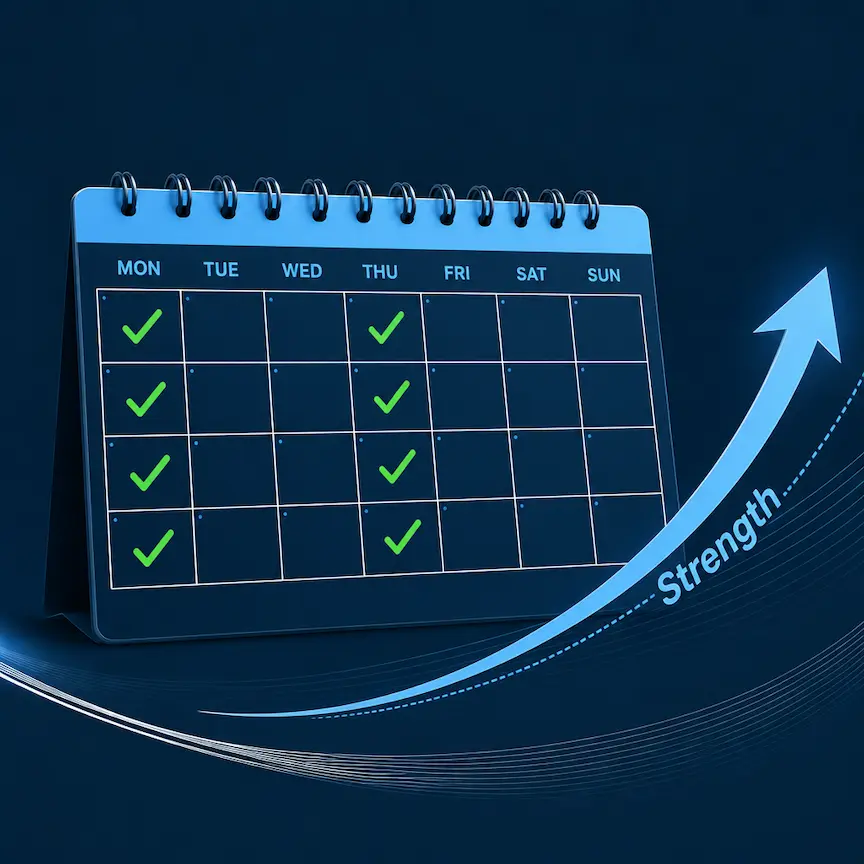
10X Fitness is a precision-engineered stress protocol built around one central principle: maximum intensity applied for a short duration triggers a stronger adaptive response than moderate intensity applied for a long duration.
This is not a marketing claim. It's exercise physiology. When you push your muscles to genuine failure — when you recruit every available motor unit, when your cardiovascular system is working at its absolute ceiling — you create a stress signal that the body cannot ignore. Recovery from that signal produces real adaptation: stronger muscle fibers, improved cardiovascular efficiency, enhanced metabolic function.
The key word is genuine intensity. Not "I'm working pretty hard" intensity. Not "this is uncomfortable" intensity. The kind of intensity that most people have genuinely never experienced in a gym setting because it requires pushing past every instinct that tells you to stop.
That's the part nobody tells you upfront. The less time you spend training — the more willing you have to be to make every second of that time count in a way that is genuinely demanding.
Power to Weight Ratio — The Number That Changed How I Train
One of the things I love most about 10X Fitness is that it gives you an objective metric to track — something most training programs completely ignore.
The metric is called power to weight ratio. It measures how much force you can generate relative to your body weight — and it's one of the most honest indicators of functional fitness that exists. You can't fake it. You can't perform your way to a good number. Either you can generate that force or you can't.
When I started tracking my power to weight ratio I was at 2.8.
Eight weeks later I was at 5.9.
To put that in context — I more than doubled my power to weight ratio in eight weeks. Training less frequently than I ever had before. Spending less total time exercising than at any other point in my fitness life.
What changed was not the volume. What changed was the intensity — and the precision with which that intensity was applied.
That number — watching it climb from 2.8 to 5.9 — told me something that years of conventional training never had: I had been leaving results on the table every single session by never pushing to where the real adaptation happens.
The One Sentence That Summarizes 10X
If I had to distill the entire 10X philosophy into a single sentence it would be this:
The less you do, the more you get — but only if you're willing to push harder than you ever have.
That second half is the part people miss when they hear the first half. Yes — shorter workouts. Yes — less frequency. But the intensity required to make that work is not comfortable. It is not pleasant. It demands something most people have never asked of themselves in a gym.
This is why I say 10X is not a shortcut. A shortcut implies you get the same result with less effort. 10X is the opposite — you get a better result with less time but more effort. Concentrated, deliberate, maximum effort applied with precision.
Most people would rather spend an hour at 60% than twenty minutes at 100%. 10X asks you to flip that equation — and the results reflect exactly that choice, which is why a structured 30-day commitment works so well.
What "Better is Better" Actually Means
The conventional fitness wisdom is "more is better." More sets. More reps. More sessions. More hours. More volume equals more results.
10X replaces that with a different standard: better is better.
Better intensity. Better form under maximum load. Better recovery between sessions. Better tracking of actual output rather than just time spent.
This shift in thinking has practical implications for how you approach every workout:
- Every rep matters — not as one of many but as a deliberate application of maximum effort
- Rest is not laziness — recovery between sessions is where adaptation happens. Cutting it short undermines the entire protocol
- Discomfort is information — the point where you want to stop is often the point where the real work begins
- Consistency beats volume — showing up consistently at high intensity outperforms sporadic sessions at high volume every time — which is exactly why a structured 30-day commitment produces better results than random effort
The Mindset Shift That Makes It Work
Here's something I've noticed coaching people through 10X — the physical adaptation is actually the easier part. The harder part is the mindset shift required to train this way.
We are conditioned to equate time spent with value delivered. An hour workout feels more productive than a twenty-minute one regardless of what actually happened in those time frames. Leaving the gym after a short session — even an intensely demanding one — triggers a quiet voice that says was that enough?
That voice is the enemy of 10X results.
Learning to trust the protocol — to measure output by intensity and adaptation rather than duration — requires rewiring a deeply ingrained assumption about what "working hard" looks like. It requires letting go of the comfort of volume and sitting with the discomfort of genuine maximum effort. Pair that with the right eating approach and the results compound.
This is where my NLP background intersects with the physical training. The unconscious patterns that pull people back to comfortable, familiar training intensities are real. Addressing them is part of what makes the difference between someone who tries 10X for two weeks and someone who transforms their fitness in eight.
Is 10X Right for You?
10X Fitness is not for everyone — and I say that honestly, not as a disclaimer.
It requires:
- A baseline of fitness — maximum intensity training on a completely deconditioned body needs careful progression
- Willingness to be genuinely uncomfortable — not just "this is hard" but "I am pushing to my actual limit"
- Patience with the protocol — trusting less frequency when every instinct says do more
- Honest self-assessment — the power to weight ratio doesn't lie. Neither does genuine maximum effort versus the performance of it
If you're someone who has been training consistently and not seeing the results that effort should produce — 10X is worth understanding seriously. The problem is almost never the willingness to work. It's the intensity at which that work is happening.
What I'd Tell Someone Starting Out
Start with the metric. Track your power to weight ratio before you change anything else. Know your number. That number will tell you more about your current fitness than any feeling or perception of effort ever could.
Then apply the intensity — genuinely, not performatively. Push past the point where you want to stop. Stay there briefly. Recover fully. Repeat.
Watch the number change.
Eight weeks from now you'll have data — objective, honest data — that shows you exactly what maximum intensity applied with precision can do. And you'll never look at a 45-minute moderate-pace treadmill session the same way again.
If the mindset side of this resonates — read what my coaching journal taught me about focus. The same principle of working at the right level rather than the comfortable level applies there too.
Get Weekly Performance Insights
One email every week — fitness strategies, focus techniques and performance insights from the coaching journal to your inbox. No filler. Just what works.
Sorin is a certified performance coach based in Canada. He writes about the intersection of physical training, unconscious mind patterns and peak performance — and what happens when you apply all three together.


Have You Tried Training This Way?
Have you ever pushed to genuine maximum intensity in a workout? What happened — and what did you discover about where your actual limit is? Leave a comment below — I read every one and respond personally.