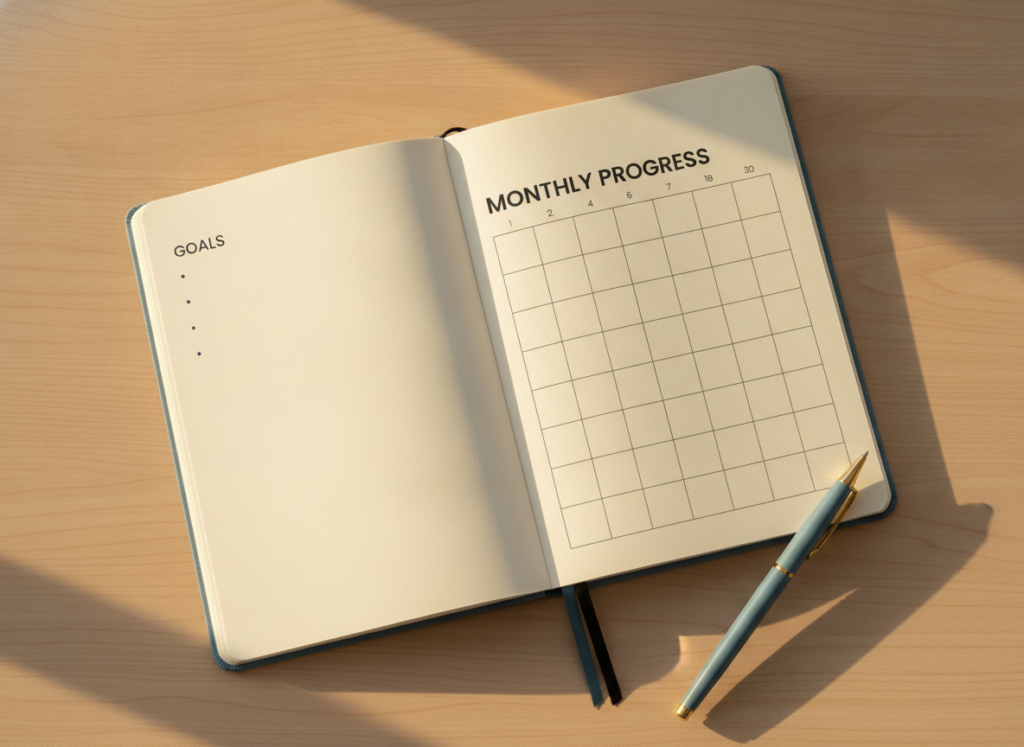
"The best challenge is not the hardest one. It's the one you can actually finish. I've seen people transform their body, focus and energy in 30 days — not by doing everything perfectly, but by doing three simple things consistently." — Sorin
Most 30-day challenges fail for the same reason most diets fail — they're built around intensity rather than repeatability. They ask you to do something dramatic for a month and then quietly assume you'll somehow maintain it afterward.
This one is different.
The 30-Day Structure Challenge is built around three simple daily commitments — one for your body, one for your mind, one for your eating. None of them are complicated. All of them compound. And the goal isn't perfection — it's consistency tracked honestly over 30 days.
If you've read my posts on intermittent fasting and eating structure or focus and the unconscious mind — this challenge is where those ideas become a daily practice.
Why 30 Days — And Why Structure
Thirty days is not a magic number. But it's long enough for a new behaviour to start feeling familiar — and short enough to commit to without feeling overwhelmed.
The research on habit formation varies — the old "21 days" claim has been largely debunked. What we know is that repetition over a consistent period creates neural pathways that make a behaviour progressively easier and more automatic. Thirty days of daily repetition gives those pathways a real foundation to build on.
Structure matters because structure removes decisions. Every decision you have to make in a day costs mental energy. A challenge built around clear structure — the same three things every day — eliminates the daily negotiation of what you should be doing and replaces it with a simple checklist you can run on autopilot.
After 30 days the structure doesn't disappear. For most people it becomes the new default — the thing they do without thinking because they've done it enough times that it's now part of how their day works.
That's the goal. Not 30 days of heroic effort. Thirty days of repeatable simplicity that installs a new baseline.
The Three Daily Commitments
Each commitment addresses one of the three pillars of this blog — focus, fitness and fat loss. They work independently. They work better together.
Commitment 1 — Move Your Body for 20 Minutes
Rule: Any movement counts. Intensity optional. Stopping is not.
Walk. Run. Lift. Play sport. Do yoga. It doesn't matter what — it matters that you move deliberately for 20 minutes every single day for 30 days.
Why 20 minutes? Because it's short enough that there's no legitimate excuse not to do it. A busy day, a tired evening, a stressful week — 20 minutes is always available if you decide it is. And deciding it is, every day for 30 days, is the point.
On days when you have energy — go harder. On days when you don't — go for a walk. The commitment is to the 20 minutes, not to the intensity. Intensity is a bonus. Consistency is the requirement.
- Minimum: 20 minutes of any deliberate movement
- Ideal: whatever you genuinely enjoy doing
- On hard days: a 20-minute walk counts fully
Commitment 2 — Follow Your Eating Structure
Rule: Pick one eating structure and follow it. Judge by consistency, not perfection.
Choose one of these — whichever fits your life most naturally:
- Option A — Eating window: eat only between noon and 8pm. Outside those hours — water, black coffee, nothing else
- Option B — No snacking: three meals, nothing between them. No negotiating with yourself at 3pm
- Option C — No eating after 7pm: simple, single rule, enormous impact for most people
Pick one. The same one every day for 30 days. Don't switch if it gets hard — that's the point where the unconscious mind is being asked to update its pattern. The discomfort on day 8 or day 12 is not a sign the structure is wrong. It's a sign it's working.
What you eat inside your structure is your choice. Real food, balanced, whatever you actually enjoy. The structure is the commitment — not the content.
Commitment 3 — Ten Minutes of Journal Writing
Rule: No agenda, no format. Just write for ten minutes before checking your phone.
This is the commitment most people underestimate — and the one that quietly transforms the other two.
Ten minutes of unfiltered writing at the start of the day does something that no productivity app or planning system can replicate: it surfaces what's actually going on underneath the surface. What you're avoiding. What's on your mind. What the unconscious mind is running that your conscious mind hasn't caught up with yet.
Over 30 days of this practice you will notice patterns. Recurring thoughts. Recurring avoidances. Recurring emotional states at specific times of day or week. That self-knowledge is the foundation that makes the other two commitments easier — because you start to see the triggers before they become behaviours.
- When: first thing in the morning — before phone, before email, before anything
- How long: exactly 10 minutes — set a timer
- What to write: whatever is in your head. No structure required
- What not to do: plan, organise, make to-do lists. This is not planning time. It's surfacing time
How to Track Your 30 Days
Tracking is not optional — it's part of the challenge. Here's why: the number that matters is not your weight, not your performance, not how you feel on any given day. The number that matters is your consistency score.
At the end of each day mark one of three things for each commitment:
- ✓ Done — you completed the commitment
- ~ Partial — you did something but not the full commitment
- ✗ Missed — you didn't do it
That's it. Three symbols, three commitments, 30 days. At the end you have 90 data points that tell you exactly what happened — not what you remember happening, not how you felt about it, but what actually occurred.
A realistic target for a first attempt: 75% consistency. That means roughly 22-23 days out of 30 where you hit all three commitments. That's not perfection. It's real life. And 75% consistency over 30 days produces measurable, lasting change.
If you hit 90%+ — remarkable. If you hit 60% — still useful. The data tells you where your resistance lives. That's information you can work with.
Get the Printable
30-Day Tracker
A branded, printable PDF tracker — one page, 30 days, three checkboxes per day. Designed to sit on your desk or stick to your fridge.
- ✓ 30-day grid with M / E / J checkboxes
- ✓ Name and start date fields
- ✓ Scoring section for day 30
- ✓ Key quote to keep you going
- ✓ Print or fill digitally
Enter your details and I'll send it straight to your inbox:
[sibwp_form id=2]🔒 No spam. Unsubscribe anytime. You'll also receive weekly coaching insights.
What to Expect — Week by Week
Week 1 — Resistance
The first week is the hardest. The unconscious mind hasn't updated yet — it's still running the old patterns and finding the new structure unfamiliar and uncomfortable. Expect to miss days. Expect cravings. Expect the journal to feel pointless. Do it anyway. The resistance is normal. It's not a sign the challenge is wrong for you.
Week 2 — Friction
Something starts to shift in week two. The structure is still effortful but slightly less unfamiliar. You start to see patterns in your journal. The 20-minute movement commitment starts feeling less like a chore and more like a fixture. Friction decreases. Don't mistake this for "it's getting easy" — stay consistent.
Week 3 — Momentum
By week three most people notice something they didn't expect — they miss the commitments on days they skip them. The structure has started to feel like their structure. Missing it creates a mild discomfort. That discomfort is the unconscious mind updating its baseline. This is exactly what you're looking for.
Week 4 — Integration
The final week is where the challenge transitions from something you're doing to something you are. Not for everyone — some people need more than 30 days for full integration. But the foundation is there. The neural pathways have been laid. What happens after day 30 is a choice — and most people who've reached week four choose to continue.
One Rule Above All Others
Don't restart after a missed day. Don't reset your counter. Don't treat a missed day as a failure that invalidates everything before it.
A missed day is data — not a verdict. Note it in your tracker. Look at why it happened — stress, schedule, avoidance? Then continue on day 32 exactly as you would have on day 31.
The challenge is 30 days of attempted consistency — not 30 days of perfect execution. Those are completely different things. One is achievable. The other is a trap.
Start Today
Pick your eating structure. Set your journal timer for tomorrow morning. Decide what movement you'll do today.
That's it. That's day one.
Come back in 30 days and leave a comment below with your consistency score. I'll respond to every one personally.
Get Weekly Support During Your Challenge
One coaching insight every week — perfect alongside the 30-day challenge. Focus, fitness and fat loss strategies from the journal to your inbox.
Sorin is a certified performance coach based in Canada. He designs structured challenges and coaching programs that work with the unconscious mind — not against it.


Are You Starting the Challenge?
Leave a comment below with which eating structure you're choosing and what day you're starting. I read every comment and respond personally — and knowing someone else knows you started makes it more likely you'll finish.