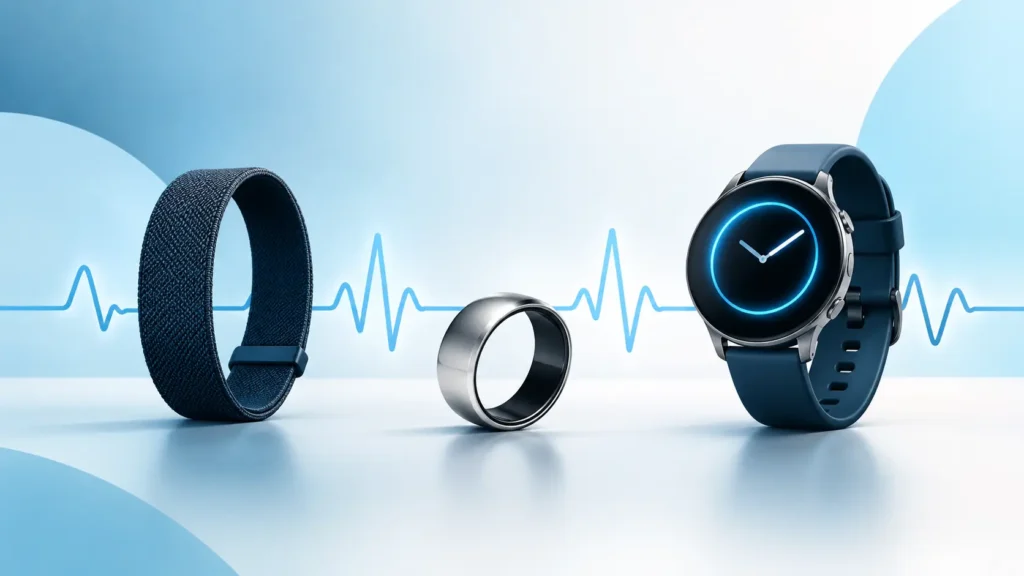
"When someone asks me which fitness tracker to buy, I answer with a question: what are you going to do differently once you have the number? If there's no answer to that, the brand doesn't matter. You're buying a very expensive way to feel watched." — Sorin
Wearable technology is the American College of Sports Medicine's number one fitness trend for 2026, and nearly half of US adults now own a fitness tracker or smartwatch. The market has never been bigger, and the buying decision has never been more confusing — because the three names that dominate the conversation, WHOOP, Oura Ring and Garmin, are not three versions of the same product. They are three different tools built for three different kinds of people.
Most comparison articles miss this. They line up a feature table — sleep tracking, heart rate variability, battery life — tick the same boxes for all three, and finish with "it depends on your needs." That tells you nothing.
I'm going to come at it as a coach rather than a gadget reviewer. The spec sheet matters less than one behavioural question: which of these will change what you do, and which will become an expensive notification machine? All prices below are in US dollars.
Three Different Tools, Not Three Versions of One
Before any specs, here is what each device is for.
WHOOP is a recovery and training-load tool. It has no screen. You wear it around the clock and everything it measures feeds one question: are you ready to push today, or should you back off? It is built on the idea that results come from the balance between how hard you work and how well you recover.
Oura Ring is a sleep and readiness tool. It is the most passive of the three. You wear a ring, you sleep, and in the morning it gives you a picture of what your body did overnight. It tells you very little about your workout and a great deal about whether you're ready for one.
Garmin is an activity and navigation tool that also tracks health. Its strength is measuring what you do while you're moving — pace, distance, route, heart rate zones — on a screen you can read mid-stride. The health features are real and getting better, but they were added to a sports watch, not the other way round.
All three track sleep. All three track heart rate variability. All three give you some kind of daily readiness score. The philosophy behind each is different, and that philosophy will either fit how you live or it won't.
WHOOP 5.0 — For the Person Who Wants a Coach, Not a Watch
WHOOP is a subscription. You don't buy the band; you pay a yearly membership and the hardware comes with it. There are three tiers:
- WHOOP One — $199/year. The 5.0 band with sleep, strain and recovery tracking, VO₂ max, heart rate zones and personalised coaching.
- WHOOP Peak — $239/year. Adds Healthspan and Pace of Aging, real-time stress monitoring and health alerts. This is the tier most people will choose.
- WHOOP Life — $359/year. Comes with the WHOOP MG hardware, which adds ECG readings, irregular rhythm detection and blood pressure insights (still in beta).
The headline feature of this generation is Healthspan. It combines nine measures — including sleep consistency, time in heart rate zones, VO₂ max and lean body mass — into a "WHOOP Age" and a Pace of Aging trend. Treat the exact number as an estimate. The useful part is the direction of the trend, because it rewards the unglamorous habits: going to bed at the same time, moving every day, doing some strength work.
Battery life is the other big change. WHOOP rates the 5.0 at 14 days or more, and independent testing backs that up — Wareable's reviewer lost only 38% in six days.
What it does best: it turns weeks of sleep and training data into plain guidance about when to push and when to rest. No screen means no notifications and nothing to check compulsively.
Where it falls short: wrist heart rate accuracy during exercise is still inconsistent in independent testing. There is no built-in GPS and no display, so you can't glance at your pace. And the cost never stops — $239 a year is $717 over three years for a band you don't own.
Who it's for: someone who trains with intent and wants to manage recovery, and who will open the app every morning and act on what it says. If you mostly want to count steps, WHOOP is the wrong purchase.
Oura Ring 4 — For the Person Who Doesn't Want to Wear a Tracker
The Oura Ring 4 starts at $349, plus a membership of $5.99 a month or $69.99 a year. Without the membership you see only basic daily scores, so count the membership as part of the price. In the US it is HSA/FSA eligible.
It is a titanium ring weighing 4–6 grams, in sizes 4 to 15. No screen, no GPS, no notifications. The battery is rated at up to 8 days; reviewers typically report 5–6 in real use. The main hardware upgrade over the previous generation is Smart Sensing, which reads from 18 signal pathways instead of 8 and cuts down on overnight gaps in the data.
Each morning you get three scores out of 100 — Sleep, Readiness and Activity — with stress and resilience trends alongside. Oura Advisor, the in-app AI, lets you ask questions about your own data in plain language. Oura has also invested heavily in cycle tracking and perimenopause insights.
On accuracy: Oura is one of the more heavily studied consumer wearables, and published comparisons against lab sleep testing rate its sleep-versus-wake detection well. Sleep stage estimates — how much deep or REM sleep you got — are less exact, as they are on every consumer device. Use them as trends, not measurements.
What it does best: you forget you're wearing it. That matters more than it sounds. A tracker only works if it's on your body every night, and plenty of people who gave up on a wrist band keep a ring on for years.
Where it falls short: activity tracking is its weakest area, and it's little use during a workout. Titanium scratches against a barbell or dumbbell. And the detailed data sits behind the membership.
Who it's for: someone whose main interest is sleep, stress and recovery; someone who dislikes wearing a watch to bed; someone who wants the picture without the gadget.
That leaves the third option — the only one of the three with a screen, built-in GPS, and no membership required.
This is an affiliate link. As an Amazon Associate I earn from qualifying purchases — at no extra cost to you.
Garmin Vivoactive 6 — For the Person Who Wants One Device That Does Everything
Garmin makes dozens of watches, most of them aimed at runners, triathletes and mountain people. For a non-athlete, two models are worth looking at.
The Vivoactive 6 costs $299. It has an AMOLED touchscreen, built-in GPS, and about 11 days of battery in normal use (closer to five with the always-on display). It tracks sleep, heart rate variability, stress, VO₂ max and menstrual cycles, and covers everything from walking and strength training to swimming and golf. It has no ECG.
The Venu 3 lists at around $450 but is often discounted. It adds ECG, a microphone and speaker so you can take calls from your wrist, and a more premium build. If none of those matter to you, the Vivoactive 6 is the better buy.
The feature that makes Garmin work for ordinary people is Body Battery: a single 0–100 number that combines sleep, stress, heart rate variability and activity to show how much you have in the tank right now. It is less detailed than WHOOP's recovery score or Oura's readiness score, but anyone can understand it in two seconds. For most people that's enough to act on.
The other difference is the cost model. You pay once and the core features are yours. Garmin does sell an optional Connect+ subscription, but nothing described in this post needs it.
What it does best: GPS, a readable screen during activity, long battery life for a full smartwatch, and no ongoing fee. If you're doing something like the 6-6-6 walking challenge, a Garmin shows you distance, pace and heart rate zone as you go. The other two can't do that without your phone.
Where it falls short: its sleep tracking is generally rated behind Oura's, and its recovery guidance is shallower than WHOOP's. It is also a screen on your wrist that buzzes. If you're already trying to cut down on notifications, turn most of them off on day one.
Who it's for: the person who walks, runs, cycles or hikes and wants to see it measured; the person who refuses to pay a subscription; the first-time buyer who isn't sure how deep they want to go.
What Each One Really Costs Over Three Years
Almost every review compares the price on day one. The more honest comparison is what you've paid after three years of wearing the thing.
| Tracker | Year 1 | Year 2 | Year 3 | 3-Year Total |
|---|---|---|---|---|
| WHOOP Peak | $239 | $239 | $239 | $717 |
| Oura Ring 4 + membership | $419 | $70 | $70 | $559 |
| Garmin Vivoactive 6 | $299 | $0 | $0 | $299 |
WHOOP costs more than twice what the Garmin does over three years. That isn't a reason to avoid it — if the coaching changes how you train and sleep, $20 a month is cheap. It is a reason to be honest about whether you'll use it.
Which Tracker Matches Which Person
Choose WHOOP if you train several times a week with a goal in mind, you want to be told when to push and when to recover, you don't want a screen, and you're comfortable paying every year for that guidance.
Choose Oura if sleep and stress are what you most want to understand, you won't wear a watch to bed, and you'd rather check one calm summary each morning than look at your wrist all day.
Choose Garmin if you want to see your walks, runs and rides measured as they happen, you want one device that also tells the time and handles the basics, and you'd rather pay once.
And if none of those descriptions sounds like you, the honest answer may be that you don't need one yet. A tracker measures habits. It doesn't create them. If you're still building the routine, a simple weekly plan and a notebook will take you further than any of these.
The Question Every Review Skips
None of these devices changes anything on its own. They report. What you do with the report is the whole game.
So before you buy, decide what the number will change. If your readiness score is low, will you swap the hard session for a walk? If your sleep score drops every time you have a late coffee or a late screen, will you stop? If the answer is yes, any of the three will pay for itself. If the answer is "I just want to see the data," you'll look at it for a month and then stop looking — and the scale has already taught most of us what happens when we collect a number without a plan for it.
Two practical rules. First, give it a month. All three need a few weeks of consistent wear to learn your baseline, and the scores mean little before that. Second, pick the one you'll keep on. The best tracker for you is whichever one is still on your body in six months.
Where to Get Each One
Garmin Vivoactive 6: check the current price on Amazon. Garmin watches are discounted often, so it's worth looking before paying list price.
WHOOP 5.0: memberships are sold directly at whoop.com.
Oura Ring 4: buy from ouraring.com, and order the free sizing kit first — ring sizes don't match standard jewellery sizes.
Some links in this post are affiliate links. I earn a commission if you purchase through them, at no extra cost to you. Prices and membership details were checked in November 2026 and may change — confirm before you buy.
The Bottom Line
WHOOP is for recovery-led training. Oura is for sleep and readiness. Garmin is for seeing your activity measured, with no ongoing fee. None of them is the best fitness tracker. Each is the right one for somebody.
Work out which somebody you are, then wear it long enough for it to tell you something.
Get Weekly Coaching Insights
One email every week — nutrition insights, fat loss strategies and performance tips from the coaching journal to your inbox. No filler. Just what works.
Sorin is a certified performance coach based in Canada. He writes about nutrition, fat loss and the unconscious patterns that make dietary change stick — or cause it to rebound.


Do you wear a tracker — and has it changed anything you do?
Tell me which one you use, how long you've had it, and one thing you do differently because of it. And if yours ended up in a drawer, I'd like to hear why. Leave a comment below — I read every one and respond personally.