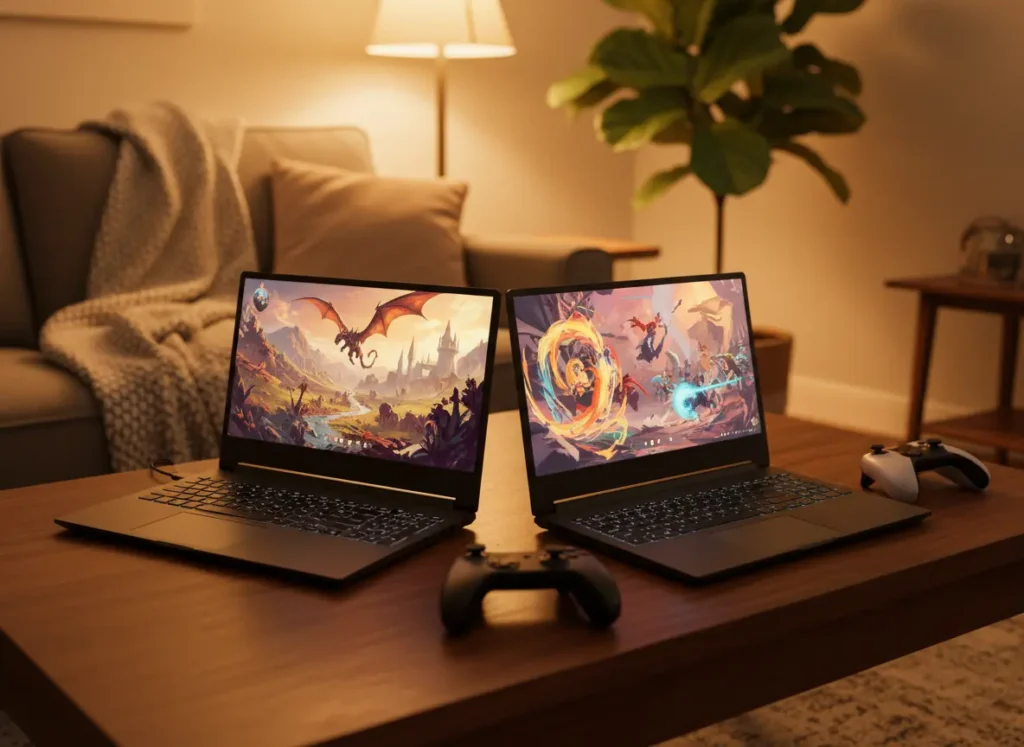
"My son leaves for university next month. I didn't plan to spend the last few weeks of summer playing video games with him — but that's exactly what happened, and I'm genuinely glad it did. What I wasn't expecting was to find something worth writing about." — Sorin
This is not the post I planned to write this week. But last Monday evening, sitting across from my son in the living room with two laptops open and a game running on both, I noticed something that I couldn't let go of — his game felt smoother than mine. Noticeably smoother. Same internet connection. Same house. Different experience. And that difference led me down a rabbit hole that ended with me writing a review of software I had never heard of three weeks ago.
Let me back up.
The Last Month Before University
My son is heading to university next month. If you've been through this as a parent — or even if you're anticipating it — you know there's this specific quality of time in those last few weeks. Ordinary things take on a weight they didn't have before. A meal together. A conversation that goes longer than it needs to. An evening that neither of you wants to end.
He's a gamer. Has been since he was old enough to hold a controller. I'm not a gamer in the way he is — my background is sport, coaching, physical performance — but I play. I always have. And somewhere in the middle of the last month of summer, we started playing together most evenings. Different games depending on the night. Sometimes competitive, sometimes just side by side in the same room doing our own thing but together.
It was during one of those sessions that I noticed it. His game was running differently to mine. Not just visually — the response. When he made a move, it registered. When I made the same move at the same moment, there was a lag — small but consistent — between input and outcome. The kind of lag that in a competitive game is the difference between a hit and a miss. The kind that in a non-competitive game just quietly drains the fun out of it without you being able to name exactly why.
I asked him what he was running. He showed me: GearUP Booster. He'd been using it for months. He was slightly smug about it in the way that only a kid who knows more than his parent about a technology can be. I made a note to look into it properly.
What GearUP Booster Actually Does
Most people's first assumption is that a "game booster" is either a VPN or a scam. GearUP is neither — and understanding why the distinction matters is the difference between dismissing it and actually understanding whether it's worth your time.
Your ISP — your internet service provider — routes your data traffic based on capacity and cost. Not speed. Not gaming performance. They're optimising for their network load, not your kill-death ratio. The software attempts to identify more efficient routes between your device and the game server — think of it like GPS navigation. Your ISP may send data through a congested route. GearUP attempts to find a faster path that reduces delays and avoids problematic network nodes.
GearUP analyses multiple routes and sends your game traffic through the fastest one, switching automatically if a route degrades. The key technical features are Adaptive Intelligent Routing (AIR) — which re-evaluates and switches your network path every 90 seconds during gameplay — and Anti-Packet-Loss technology, which sends duplicate packets along multiple routes simultaneously so whichever arrives first is the one the game registers. For Wi-Fi players especially, that packet loss fix is significant.
What it doesn't do: it doesn't increase your internet speed. It doesn't help if your problem is bad Wi-Fi signal, weak hardware, or a fundamentally poor base connection. GearUP works meaningfully for cross-region play — connecting to servers in a different continent. For same-region play with already-good routing, it adds negligible benefit and can occasionally add 2–5ms. It's a routing tool, not a miracle. But for the problem it's designed to solve — getting your game packets from your device to the server via the fastest available path — it does exactly what it says.
The Numbers — What the Testing Actually Shows
The pitch deck my contact at GearUP shared with me included a real-world comparison table that I found credible precisely because it showed results on a sliding scale rather than making blanket claims. Playing Fortnite from the US to NA servers: ping dropped from 26ms to 16ms. From Brazil to Brazilian servers: 63ms down to 43ms. From Russia to European servers: 46ms down to 30ms. From Italy to European servers: 20ms down to 13ms.
Independent 2026 reviews corroborate this range. In testing, GearUP reduced ping by 18–45% on cross-region servers. More impressive than ping reduction was packet loss improvement — packet loss even at 1–2% causes stuttering and skill shot desync in competitive games. Dropping it below 0.5% had a noticeably smoother gameplay feel.
In one review testing on a fiber connection in Europe playing Valorant and Apex Legends on North American and Asian servers, ping reduced by 45% and packet loss dropped to 0%. That's a meaningful result — not marketing copy.
It has 80 million registered users, 2.5 million monthly active users, a 4.9 out of 5 on Trustpilot from over 2,300 reviews, and 4.3 stars on the Microsoft Store from 411 ratings. Fourteen years in business, headquartered in Singapore, operating thousands of server nodes globally. This is not a startup running on hype.
This is an affiliate link. I earn a commission if you purchase — at no extra cost to you.
What My Son's Experience Actually Showed
After that first evening where I noticed the difference, I asked him to walk me through what he was seeing on his end. He pulled up the GearUP overlay — a small in-game display that shows your ping and packet loss in real time. His ping to the game server was running 20-25% lower than mine on the same connection. His packet loss was sitting at 0%. Mine was fluctuating between 1-2% — small numbers that sound inconsequential until you understand that even 1% packet loss in a fast-paced multiplayer game creates the rubber-banding and desync that makes a good player feel average and an average player feel completely outclassed.
He'd downloaded GearUP months earlier after a friend recommended it. Setup was under two minutes — download the client, launch the game through GearUP, done. It detects supported games automatically and activates without manual configuration. For someone who is not interested in network settings and just wants their game to work better, that simplicity is the product.
His reaction when he showed me the before and after numbers was the kind of quiet satisfaction that comes from having figured something out that the adults in his life hadn't. I let him have it. He'd earned it.
Who This Is Actually For — And Who It Isn't
I want to be honest with you the way I'd want someone to be honest with me, because this is a review and not an advertisement.
GearUP will make a noticeable difference if: You play online multiplayer games competitively or semi-competitively. You connect to servers in other regions — playing EU games from Canada, NA games from Europe, or any cross-region situation. You're on Wi-Fi rather than a wired ethernet connection. You experience ping spikes during peak hours when your ISP's network is congested. You play on a laptop rather than a desktop with a dedicated wired connection.
GearUP probably won't make a noticeable difference if: You're already on a wired gigabit connection with excellent local routing. You play exclusively on servers in your own region with already-low, stable ping. Your gaming problems are hardware-related — low FPS, overheating, insufficient RAM — rather than network-related. It does not help when the bottleneck is your Wi-Fi signal quality, your hardware, your local bandwidth, or the game's own servers.
The three-day free trial is the correct way to evaluate this. Results depend entirely on your ISP and target server — use the trial to measure your specific improvement before buying. Run a session without it. Run a session with it. Look at the ping and packet loss numbers in both. If the numbers move meaningfully, the subscription is worth it. If they don't, you've lost nothing.
The Coaching Lens — Why This Actually Matters for Performance
I'm going to bring this back to what this blog is actually about, because there's a genuine connection here that I don't want to skip over.
Everything I write about on this site — focus, mental clarity, training efficiency — is about removing the friction between your intention and your output. The same principle applies in a gaming context. When your ping is 45ms higher than it should be, you're not playing the game — you're fighting the network. When your packet loss is creating phantom desync, your reads on the game state are incorrect. You make decisions based on information that is already out of date by the time it reaches you.
For a competitive gamer, that's the difference between ranked and unranked, between improving and plateauing, between enjoying the game and blaming themselves for losses that were network problems disguised as skill gaps. The same way the scale lies to someone tracking their fat loss, a lagging connection lies to a gamer about their actual ability level.
Probably my son is going to be playing online in his spare time from his university accommodation next month. New city, new ISP, new routing, new network conditions I can't control or predict. He's taking GearUP with him. That's probably the most useful thing I can tell you about whether I think it works.
The Final Evening
I'm going to end this post where it started — not with a product specification but with a Tuesday evening in a living room with two laptops open.
We played for about three hours that night. I installed GearUP on my machine partway through after he showed me the numbers — my ping came down, the game smoothed out, and the session felt different in a way that was hard to attribute to anything else. He beat me more often than I beat him for the rest of the evening, which he will be quick to point out had nothing to do with the software. He's probably right.
Next month he'll be gone. The living room will be quieter. The second laptop won't be open on the coffee table. These are the things you know are coming and still somehow feel unprepared for when they arrive. But for last Monday evening, and the Monday before it, we were both just there — playing, competing, talking about nothing important, being present in the specific way that time with people you love before a change tends to make you.
If you have a gamer in your life — a kid, a partner, yourself — who is dealing with lag and packet loss and the quiet frustration of a connection that isn't performing the way it should, try GearUP free for three days. The trial is genuinely free. The setup is two minutes. The numbers will tell you everything you need to know.
Get Weekly Coaching Insights
One email every week — nutrition insights, fat loss strategies and performance tips from the coaching journal to your inbox. No filler. Just what works.
Sorin is a certified performance coach based in Canada. He writes about nutrition, fat loss and the unconscious patterns that make dietary change stick — or cause it to rebound.


Do you game with your kids — and how has that changed as they've gotten older?
I'm curious how many parents on this site have found gaming as a connection point rather than a point of conflict. And if you've used GearUP or any other network booster, I'd genuinely like to know what your experience was — what it fixed and what it didn't. Leave a comment below. I read every one and respond personally.