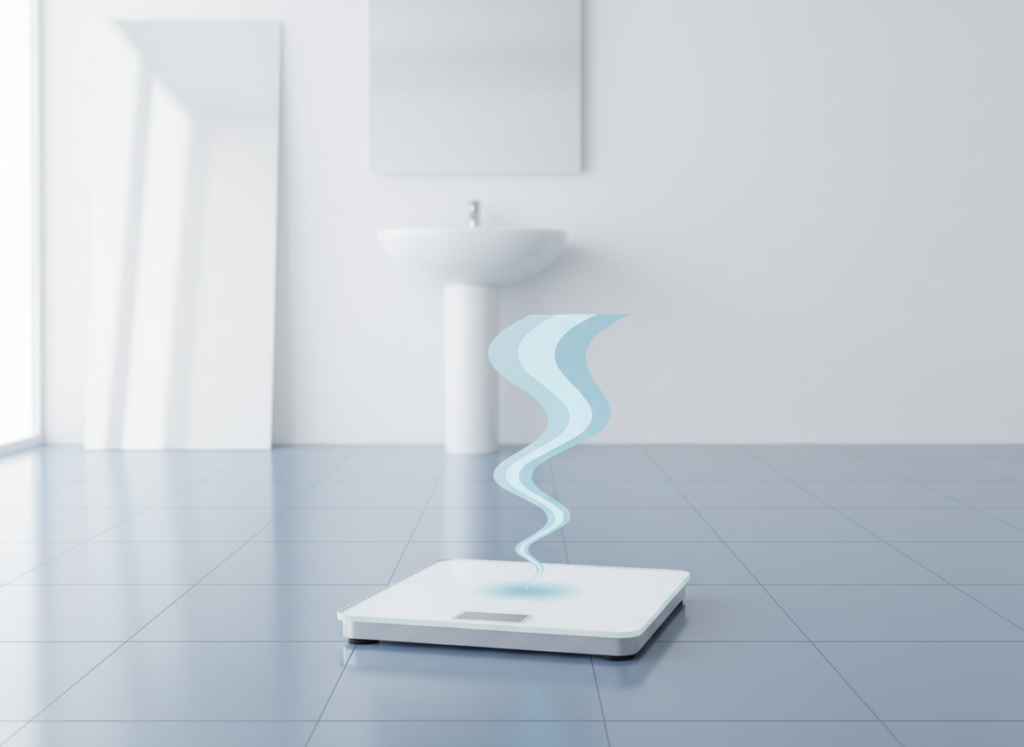
"I lost 10kg over the course of my own fat loss work — but if you'd asked me on any single Tuesday whether it was working, the scale would have told you no more often than it told you yes." — Sorin
I lost 10kg. But there were entire weeks where the scale went up.
Not stayed the same. Went up. While I was eating well, training consistently and doing everything that should have been moving the number down. If I had judged progress purely by what the scale said on those mornings, I would have quit more than once.
This is one of the most common patterns I see coaching people through fat loss — and one of the least talked about. The scale is treated as the single source of truth. It isn't. It's a noisy, unreliable instrument that happens to also measure body fat, buried under a pile of other variables that have nothing to do with fat loss at all.
What the Scale Actually Measures
Here's the part that surprises most people: a bathroom scale doesn't measure fat loss. It measures total mass pulled toward the earth at that exact moment — fat, yes, but also water, food currently in your digestive system, glycogen stores, and inflammation, all mixed into one number with no way to tell you which part changed.
On any given day your weight can shift by 1 to 3kg purely from factors that have nothing to do with whether you're losing fat. That's not a small margin of error. That's enough to completely mask weeks of real progress — or create the illusion of progress that isn't actually happening.
Water Retention
Sodium intake, carbohydrate intake, hormonal cycles, stress levels and even ambient temperature all affect how much water your body is holding at any given time. A higher-sodium meal the night before can show up as an extra kilogram the next morning that has nothing to do with fat.
Glycogen Storage
Every gram of carbohydrate your body stores as glycogen is bound together with roughly 3 grams of water. Eat a higher-carb day after a few lower-carb days and your glycogen stores refill — pulling water in along with them. The scale reads this as weight gain. It's actually fuel and hydration being restocked.
Hormonal Fluctuation
For many people, hormonal cycles create predictable multi-day windows of water retention that can add a kilogram or more, independent of anything related to diet or training.
Inflammation
A hard training session causes microscopic muscle damage as part of the normal adaptation process. The body's inflammatory response to that damage involves fluid retention in the affected tissue. Train legs hard on Monday and the scale on Tuesday is, in part, measuring how inflamed your leg muscles currently are — not how much fat you lost.
This is one of the reasons I'm such an advocate for training with intensity rather than volume. As I wrote in 10X Fitness Method — Train Less, Get More Results, fewer, harder sessions still create real inflammation and water retention in the days after — but they do it more efficiently, with less total time spent in a state where the scale is going to mislead you.
None of these factors are problems. They're normal physiology. The problem is asking a single number to represent all of them at once and then treating that number as the verdict on whether your week worked.
What the Research Actually Shows
This isn't just coaching anecdote. Body composition research consistently shows that day-to-day scale weight is a poor proxy for fat mass changes specifically. Studies tracking body water alongside body weight have found that short-term fluctuations in total body water can easily exceed the actual rate of fat loss someone is achieving in a given week — meaning the scale's daily movement is, more often than not, dominated by water rather than fat.
This is also why real-world fat loss rarely shows up as a smooth descending line. It shows up as a noisy, jagged pattern that trends downward over weeks and months, with individual days and even individual weeks that look like nothing is happening or that things are moving backward.
The lesson isn't that the scale is useless. It's that a single reading is close to meaningless. A trend across several weeks is where the real signal lives.
What I Measure Instead
Once I stopped treating the scale as the verdict, I needed something to replace it with — because "just trust the process" isn't satisfying when you want to know if what you're doing is actually working. Here's what I use instead, and what I have clients track.
1. Weekly Average, Not Daily Reading
Weigh in every day if you want the data, but only look at the seven-day average compared to the previous week's seven-day average. This single change removes most of the noise described above. A weekly average smooths out the water-retention spike from Tuesday's salty dinner and the glycogen rebound from Thursday's higher-carb meal.
2. Body Composition, Not Just Body Weight
This is the measurement that actually answers the question people care about: am I losing fat, or just losing weight. The two are not the same thing, and a scale that only reports total weight cannot tell you which one is happening.
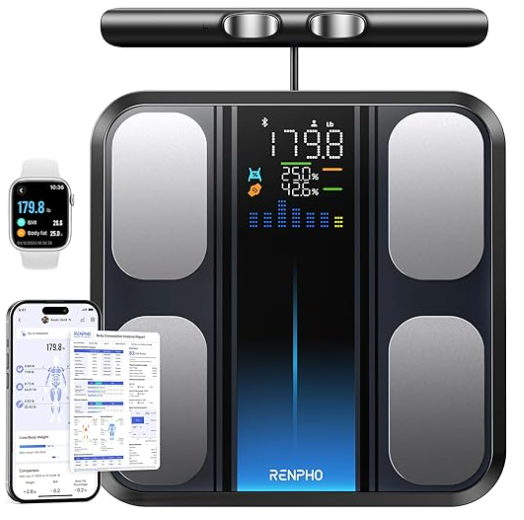
This is where a body composition scale earns its place. Unlike a standard bathroom scale, it uses a small electrical signal through your feet to estimate the proportion of your weight that's fat versus lean mass. It's not laboratory-precise, but it's precise enough to show you a trend over weeks — which is exactly the level of precision that matters here.
I use a RENPHO Smart Body Fat Scale for this. It's an accessible, well-reviewed option that connects to a phone app and tracks body fat percentage alongside weight, so you can watch the metric that actually matters move in the right direction even during weeks when total weight refuses to budge.
As an Amazon Associate I earn from qualifying purchases.
3. How Clothes Fit
Low-tech, but reliable. Pick one pair of pants or one item you wear regularly and pay attention to how it fits week over week. Fabric doesn't fluctuate with sodium intake. This is one of the most honest progress indicators available and it costs nothing.
4. Progress Photos, Same Conditions
Same lighting, same time of day, same minimal clothing, roughly every two weeks. The scale can be flat for three weeks while a photo comparison shows a visible change. Photos catch what the number misses.
5. Performance Markers
Are you recovering faster between sets. Is the same training load feeling easier. Is your resting heart rate trending down. These are downstream signs of improving body composition and overall fitness that have nothing to do with what the scale says on a Tuesday morning.
The same pattern applies to mental performance, which is a parallel I explored in How to Improve Focus Naturally — A Coach's Journal: the markers that actually tell you something is working are rarely the obvious daily number. They're the quieter signals — recovery, clarity, consistency — that build up underneath it.
As an Amazon Associate I earn from qualifying purchases.
Structure Beats Scale-Watching
Underneath all of this is a bigger pattern I see constantly in coaching: people who build their entire sense of progress around a single daily number tend to abandon their plan the moment that number misbehaves. People who build a structure — a repeatable way of eating and training that they trust independent of daily feedback — tend to stay consistent long enough for the real trend to show up.
This is the same principle behind the eating structure I wrote about in Intermittent Fasting for Weight Loss — A Coach's Journal: the goal isn't to perfectly interpret every signal your body sends you every day. It's to build a system simple enough to follow even when the feedback is confusing, noisy, or temporarily discouraging.
It's also the real reason most diets fail long-term, which I dug into in Why Every Diet Works — And Why You Gain It Back. The diet itself is rarely the variable that determines whether someone keeps the weight off. The deciding factor is whether they had a structure they trusted enough to stick with past the weeks when the feedback — scale included — looked discouraging.
For anyone who finds the scale-watching cycle particularly hard to escape — checking constantly, feeling derailed by every uptick — having a more structured framework to follow can remove a lot of that day-to-day decision fatigue. I've been looking into Keto Creator recently as one option in this space — it's built around giving you a defined structure to follow rather than asking you to interpret ambiguous daily numbers, which lines up with everything in this post about why structure outperforms scale-watching. I haven't run it long enough myself to give a full review, but the core premise is the same one I'd recommend to anyone stuck checking the scale every morning: a system you trust beats a number you're constantly trying to interpret.
What I'd Tell Someone Who Just Had a Bad Scale Week
If the number went up this week and you've been doing the things — eating with intention, training consistently, sleeping reasonably well — the scale is very likely reflecting water, glycogen, hormones or inflammation. Not fat gain. Not failure.
Look at the weekly average instead of the daily number. Check body composition if you have access to it. Check how your clothes fit. Give it three more weeks before drawing any conclusion at all.
If you want a concrete structure to fall back on during exactly this kind of week, The 30-Day Structure Challenge — Move, Eat, Journal is built for this. It replaces daily scale-checking with a small set of repeatable actions, so progress is judged by what you did, not by a number that's lying to you on any given morning.
I lost 10kg moving through exactly this kind of noisy, non-linear data. The weeks where the scale went up were not the weeks where I was failing. They were just the weeks where the scale was lying.
Get Weekly Coaching Insights
One email every week — fat loss strategies, fitness insights and performance tips from the coaching journal to your inbox. No filler. Just what works.
Sorin is a certified performance coach based in Canada. He writes about fat loss, fitness and the unconscious patterns that make transformation stick — or prevent it from happening at all.



Has the Scale Ever Lied to You?
Have you ever had a week where you did everything right and the scale went the wrong way anyway? What did you do — quit, push through, or switch to a different metric? Leave a comment below — I read every one and respond personally.