"I was looking up a recipe for bear stew this morning — and yes, that's a real thing I actually cooked — and somewhere between browning the meat and adding the root vegetables, I started thinking about food combining. Not because bear stew is particularly nutritious. Just because the smell of meat and potatoes together made me remember the Instagram post I'd seen the night before telling me that was the worst thing I could do to my body. So I finished the stew, ate it, and then spent two hours reading studies. Here's what I found." — Sorin
Food combining is the idea that what you eat matters less than which foods you eat together — and that certain combinations actively harm your digestion, block nutrient absorption, or cause your food to ferment in your stomach. The Hay Diet popularised it in the 1930s. Fit for Life brought it back in the 1980s. Instagram brought it back again in 2026, with confident reels explaining why protein and carbs at the same meal is the reason you're bloated, tired, and not losing weight. I read the actual studies. Here is an honest summary.
The short version: most of it is not supported by evidence. But two exceptions are real, well-researched, and worth knowing about — and those two are the ones nobody on Instagram seems to be talking about.
Where Food Combining Comes From — and Why It Sounds Plausible
The core theory of food combining rests on a set of claims about digestion that sound logical if you don't look too closely. The argument goes like this: different macronutrients require different enzymes and different pH environments to be digested. Proteins need acidic conditions and protease enzymes. Carbohydrates need more alkaline conditions and amylase. Eating them together causes these systems to "cancel each other out" — the enzymes compete, the pH signals conflict, and the result is incomplete digestion, fermentation, and all the bloating and fatigue that follow.
It sounds reasonable. The problem is that it doesn't describe how the human digestive system actually works.
Current scientific evidence does not support the claim that protein and carbohydrate combinations impair digestion. Multiple dietary and gastroenterology associations describe food combining as lacking scientific evidence and not recommended in clinical practice. The stomach doesn't choose between enzymes — it produces all of them simultaneously. The small intestine doesn't require foods to arrive separately to process them. The digestive system is designed specifically to handle mixed meals because mixed meals are what humans have always eaten.
The broccoli argument makes this concrete: broccoli contains both protein and carbohydrate in the same vegetable. If the enzyme-competition theory were correct, broccoli would be a digestive disaster. Nobody claims this. The theory quietly exempts whole foods from its own rules, which is the clearest possible sign that the rules aren't actually about physiology.
The Myths — What the Studies Actually Say
Myth 1: Protein and carbs shouldn't be eaten together. There are no clinical studies supporting the idea that separating meals into strict food combinations improves health or digestion. Combining protein with carbohydrates actually helps slow digestion and reduce glucose spikes — the opposite of what food combining advocates claim. Post-workout nutrition science makes this even clearer: the optimal recovery meal is protein plus carbohydrates together, because the carbohydrate spike triggers insulin which drives amino acid uptake into muscle. Separating them is specifically worse for recovery, not better.
Myth 2: Fruit must be eaten alone on an empty stomach. The claim is that fruit digests quickly and will "rot" or "ferment" if trapped behind slower-digesting foods. There is no evidence that combining fruit with other foods leads to fermentation or digestive problems in most people. The stomach's acid environment is not a comfortable place for fermentation — that's the point of stomach acid. Fruit eaten with a meal digests normally alongside everything else.
Myth 3: Different proteins shouldn't be mixed. The idea that eating chicken and fish in the same meal overwhelms the digestive system has no mechanistic basis. Proteases don't care which animal a protein came from. They break down amino acid chains. The source is irrelevant to the enzyme.
Myth 4: Fats and proteins slow digestion dangerously. While fats do slow the emptying of the stomach, this is not necessarily a negative effect. Slower gastric emptying means more sustained satiety, more stable blood sugar, and more gradual nutrient absorption. This is generally desirable, not a problem to be avoided.
The One Real Exception That Makes This All Worth Knowing
Here's where it gets genuinely interesting — because the complete dismissal of food combining misses two pairings that are real, evidence-based, and practically useful.
Vitamin C and non-heme iron. Non-heme iron is the form of iron found in plant foods — spinach, lentils, fortified cereals, tofu. It's dramatically less bioavailable than heme iron from animal sources. As little as 50mg of vitamin C consumed alongside a plant-based meal can increase non-heme iron absorption by approximately two to three times. Multiple controlled human trials over four decades consistently show that ascorbic acid co-ingested with non-heme iron sources significantly increases fractional absorption.
The mechanism is well understood: vitamin C reduces ferric iron to ferrous iron, which the intestinal lining can absorb efficiently, and it counteracts compounds like phytates and polyphenols in plant foods that block iron absorption. A meta-analysis of 26 controlled studies confirmed an average increase of 5.87 percentage points in non-heme iron absorption when vitamin C is added to a meal — a consistent finding across more than 300 participants with very low variability between studies.
What this means practically: if you eat plant-based iron sources — spinach salad, lentil soup, fortified oats — and you add vitamin C to the same meal, you absorb meaningfully more iron. Squeeze lemon on your spinach. Add bell pepper to your lentils. Have a glass of orange juice with your fortified cereal. These are not wellness tricks — they are nutritional leverage with strong evidence behind them. For vegetarians, vegans, or anyone whose diet is heavy on plant protein, this pairing is one of the most useful things you can do.
This is an affiliate link. I earn a small commission if you purchase — at no extra cost to you.
The Second Real Exception — Fat and Fat-Soluble Nutrients
The second evidence-based pairing is less well-known but equally well-researched: dietary fat significantly improves the absorption of fat-soluble vitamins and carotenoids from vegetables.
Fat-soluble nutrients — vitamins A, D, E, and K, and carotenoids like lycopene, beta-carotene, and lutein — require fat to be absorbed. They don't dissolve in water. They dissolve in fat, and they move from your gut into your bloodstream packaged inside fat-containing particles called chylomicrons. Without fat in the same meal, these nutrients pass through your digestive system largely unabsorbed.
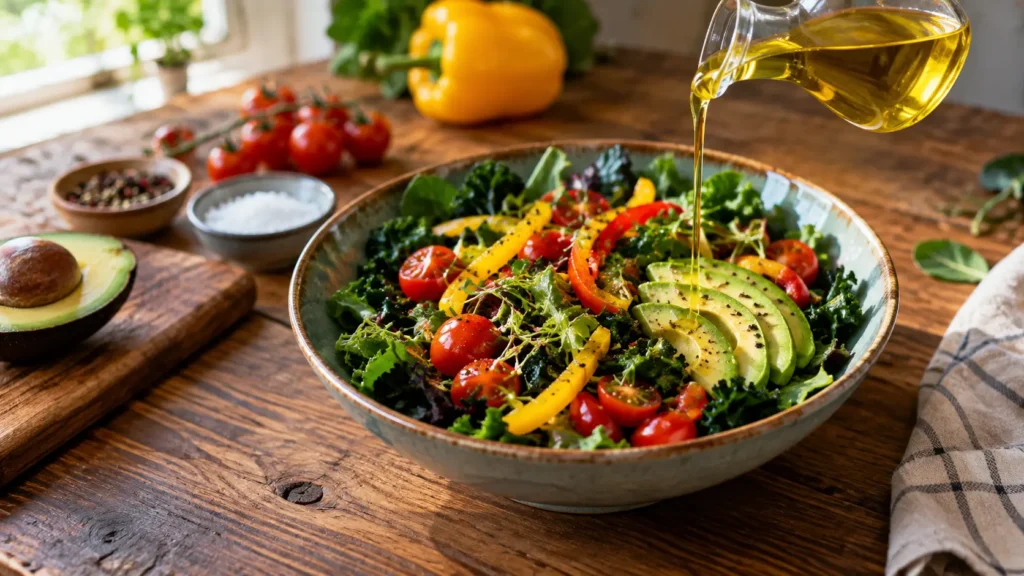
The research on this is robust. A 2012 study published in Molecular Nutrition and Food Research tested salad absorption with three different dressings — fat-free, low-fat, and full-fat — and found that carotenoid absorption from the vegetables was dramatically higher with the full-fat dressing. A 2004 study in the American Journal of Clinical Nutrition found that adding avocado to salsa tripled the absorption of lycopene from tomatoes and significantly increased beta-carotene absorption. Adding avocado to salad increased alpha-carotene, beta-carotene and lutein absorption by 7 to 18 times compared to a fat-free salad.
The practical implication is significant: the low-fat salad dressing that diet culture has promoted for decades is specifically counterproductive for the nutrient absorption it's supposed to support. A salad eaten with olive oil, avocado, or a full-fat dressing delivers dramatically more nutritional value than the same salad eaten dry or with a fat-free dressing. The calories in the oil are the delivery mechanism for the vitamins in the vegetables. Remove the delivery mechanism, remove the vitamins.
What This Means for How You Actually Eat
Let me pull this together into something practical because this is the kind of topic that can generate a lot of anxiety about meals if you let it.
The anxiety is not warranted. The same principle that explains why obsessive diets fail applies here — adding rules and restrictions to eating creates friction, stress, and eventually non-compliance. The goal is not to restructure every meal around optimisation rules. The goal is to understand two genuine exceptions and apply them where it's easy.
Here's how I think about it:
Eat your protein and carbs together. Chicken and rice. Meat and potatoes. Bear stew with root vegetables. The food combining rules about separating macronutrients are not based on evidence. Eat normal meals. The digestive system was built for this.
Add fat to your vegetables. Drizzle olive oil or avocado oil on your salad. Add avocado to anything with tomatoes. Roast your vegetables in oil rather than steaming them dry. This is not optional extra calories — it's the delivery mechanism for the vitamins in the vegetables. The choice of which fat to use matters less than the fact of using one at all.
Add vitamin C to plant-based iron sources. If you eat spinach, lentils, beans, tofu, or fortified grains, pair them with something high in vitamin C in the same meal. Lemon juice on lentils. Bell pepper in a bean salad. Tomatoes with iron-fortified pasta. This is especially relevant if you eat a plant-heavy diet and want to maximise what you're actually absorbing from it. The structure of what you eat around your meals is as important as what you eat in them.
Everything else — the rules about fruit alone, proteins not mixing, fats and proteins being incompatible — discard it. There is no credible evidence for any of it.
About the Bear Stew
Since I mentioned it: yes, I actually made it. Bear meat is surprisingly lean — leaner than most beef — with a strong, gamey flavour that needs slow cooking and robust root vegetables to balance it. I used carrots, parsnips, and potatoes, which I'm now aware is an evidence-free combination from a food-combining perspective, but which tasted exactly as good as meat and potatoes always tastes. I used avocado oil to sear the meat first, which means I inadvertently applied one of the two evidence-based pairings in this post — fat alongside fat-soluble vitamins in the root vegetables — entirely by accident.
That's more or less the conclusion of six studies worth of reading: eat real food, cooked properly, with some oil on the vegetables and something acidic with the legumes. The rest is noise.
Get Weekly Coaching Insights
One email every week — nutrition insights, fat loss strategies and performance tips from the coaching journal to your inbox. No filler. Just what works.
Sorin is a certified performance coach based in Canada. He writes about nutrition, fat loss and the unconscious patterns that make dietary change stick — or cause it to rebound.



Have you ever followed food combining rules — and did you notice any actual difference?
I'm genuinely curious how many people have tried the Hay Diet or Fit for Life or similar approaches and what the experience was. And if the vitamin C and iron pairing or the fat and carotenoid pairing is new to you — are you going to apply it? Leave a comment below. I read every one and respond personally.