
"My job as a coach is not to tell you what to think. It's to give you enough of the actual evidence that you can stop being pushed around by whoever is loudest on the internet this week." — Sorin
Seed oils have become the most politically charged ingredient in your kitchen. In January 2026, the US Department of Health and Human Services released new dietary guidelines that pointedly omitted seed oils while listing butter and beef tallow alongside olive oil as acceptable cooking fats. RFK Jr. declared the end of "the war on saturated fats" and called canola, corn, soybean, and sunflower oils among the most unhealthy aspects of the American diet. If you've been confused about what to believe — you're not alone, and the confusion is understandable. Here's what the actual science says.
Let me be clear upfront about where I stand on this: my job is not to defend seed oils, and it's not to demonize them either. My job is to help you cut through the noise. And right now, there is a significant disconnect between what's being said in Washington and what's being shown in the peer-reviewed literature — and you deserve to know exactly what that gap looks like.
What RFK Jr. and the 2026 Guidelines Actually Say
The January 2026 dietary guidelines represented a significant departure from decades of prior guidance. Previous guidelines had recommended limiting saturated fat to less than 10% of daily calories and replacing it with oils including canola, corn, soybean, and sunflower. The new guidelines discarded 421 pages of recommendations from the scientific advisory committee and inverted the food pyramid to emphasize meat and dairy over whole grains.
RFK Jr. and his Make America Healthy Again initiative have been particularly vocal about what they call the "Hateful Eight" — canola, corn, cottonseed, grapeseed, rice bran, soy, sunflower, and safflower oils. Kennedy has posted publicly that Americans are being "unknowingly poisoned" by these oils and called them "one of the driving causes of the obesity epidemic." Louisiana has even considered requiring restaurant disclaimers for dishes cooked in these oils.
The concern driving this position centres on two things: the industrial processing used to extract seed oils, and their high content of omega-6 polyunsaturated fatty acids — specifically linoleic acid — which critics argue promotes systemic inflammation and contributes to chronic disease.
These concerns sound serious. The question is whether the evidence supports them.
What the Peer-Reviewed Research Actually Shows
Here's where the disconnect becomes stark. The collective body of nutrition research tells a different story than the headlines.
A 2026 study published in Nutrition Today reviewed the health implications of linoleic acid — the primary omega-6 fatty acid in seed oils — and found that observational evidence consistently shows higher linoleic acid intake is associated with lower risk of cardiovascular disease. Critically, clinical trial evidence shows that linoleic acid does not promote inflammation or oxidative stress — the two central claims of the anti-seed oil movement.
This is backed by a study presented at the American Society for Nutrition's flagship meeting in 2025, where researchers analyzed blood markers from nearly 1,900 people and found that higher levels of linoleic acid in blood plasma were associated with lower levels of biomarkers of cardiometabolic risk, including inflammation markers. "Our study found that higher linoleic acid in blood plasma was associated with lower levels of biomarkers of cardiometabolic risk, including those related to inflammation," the lead researcher noted — the opposite of what the anti-seed oil narrative claims.
The Johns Hopkins Bloomberg School of Public Health has stated plainly that seed oils do not cause inflammation, calling the concern a misunderstanding of how omega-3 and omega-6 fatty acids work in the body. Their research found that participants with the highest levels of linoleic acid had a 35% lower risk of developing type 2 diabetes compared to those with the lowest levels.
Perhaps most striking: a 2020 Cochrane systematic review — considered the gold standard of medical evidence — analysed roughly 59,000 participants across 15 randomised controlled trials and found that replacing saturated fat with polyunsaturated fat reduced combined cardiovascular events by 21%. The American Heart Association has noted that this risk reduction is comparable to the benefits of statin medications.
Why the Confusion Exists — and Why It's Legitimate
This isn't purely a case of misinformation versus science. There are legitimate nuances in this debate that get lost when the argument becomes political.
The omega-6 inflammation argument is based on real biochemistry — linoleic acid can be metabolised into arachidonic acid, a precursor to pro-inflammatory compounds. The problem is that studies show only a small percentage of linoleic acid actually converts to arachidonic acid in the body, and two separate systematic reviews of randomised controlled trials found that higher omega-6 intake had no effect on inflammatory markers in practice.
The processing concern also has a kernel of truth. Industrial extraction of seed oils does involve heat and chemical solvents. However, the British Heart Foundation notes that the trace chemicals present in finished seed oils are regulated to safe levels. The bigger concern — one that nutrition scientists and MAHA critics actually agree on — is that seed oils are disproportionately found in ultraprocessed foods. And there is strong evidence linking ultraprocessed food consumption to poor health outcomes. The issue may not be the oil itself but what it's cooked in, combined with, and sold alongside.
As NBC News reported, "nutrition experts say the bigger concern is the ultraprocessed foods that are cooked in these oils." That's a meaningful distinction that the loudest voices on both sides tend to skip over. The oil you drizzle on your vegetables at home and the oil used to deep-fry fast food for hours at a time are not equivalent situations — even if they come from the same bottle.
This is an affiliate link. I earn a small commission if you purchase — at no extra cost to you.
What About Olive Oil — Is It Really Different?
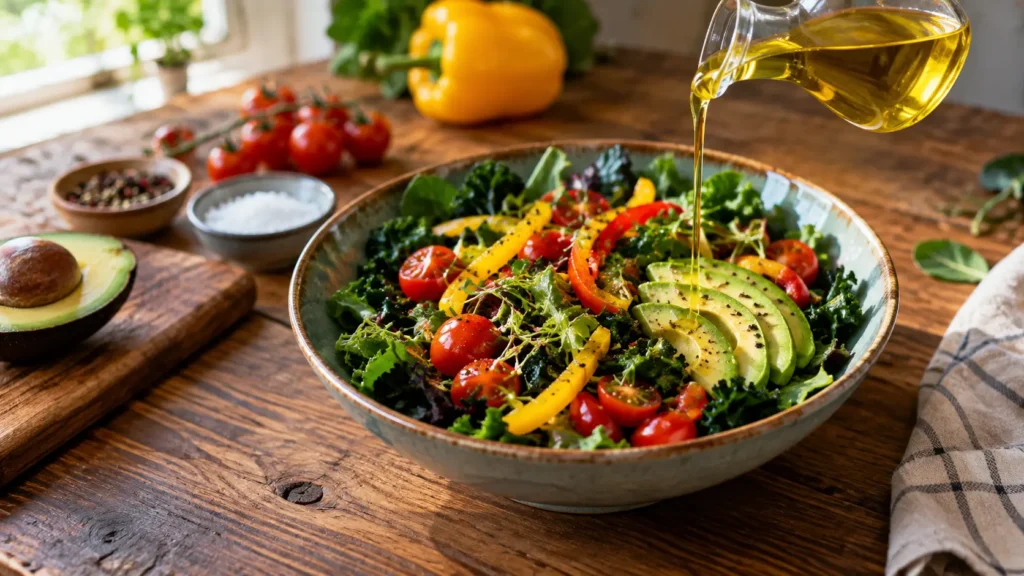
Both the old guidelines and the new ones agree on one thing: olive oil belongs in a healthy diet. And there's a reason for that consensus. Olive oil is predominantly monounsaturated fat — a different category entirely from the polyunsaturated fats in seed oils and the saturated fats in butter and tallow. Decades of Mediterranean diet research have consistently shown cardiovascular benefit from olive oil consumption.
Avocado oil sits in a similar category — high in monounsaturated fat, with a high smoke point that makes it practical for cooking at higher temperatures. If you're looking to simplify the decision and sidestep the debate entirely, these two oils are the most defensible choices regardless of which side of the seed oil argument you find yourself on.
The new 2026 guidelines' recommendation of olive oil as the primary fat while also accepting butter and beef tallow does create an odd situation where the guidelines are simultaneously more conservative and more permissive than previous guidance — depending on which nutrient you're looking at. It's worth noting that a team of epidemiologists at Defend Public Health described the implication that butter and beef tallow are healthy fats as having no scientific support. Cardiologists have raised concern about patients in cardiac rehab quietly switching from olive oil to beef tallow based on the new guidelines — a population where the cardiovascular consequences of that switch are not trivial.
The Practical Framework — How to Actually Make This Decision
Here's how I think about this as a coach, and how I'd suggest you think about it too.
The research does not support avoiding seed oils used in moderation as part of a whole-food diet. The same principle that explains why extreme dietary restriction backfires applies here — panic-driven elimination of a whole food category based on contested evidence is rarely the move that improves your health outcomes. The evidence for harm from modest seed oil use in home cooking is not there.
What the evidence does support — strongly — is reducing ultraprocessed food consumption. If seed oils concern you, the most meaningful action you can take is not swapping your cooking oil at home. It's reducing the foods that are deep-fried, shelf-stable, and engineered for overconsumption — the foods that happen to contain large amounts of industrial seed oils alongside refined carbohydrates, artificial flavouring, and preservatives. Eating within a structure that emphasises whole foods automatically reduces your seed oil exposure without requiring you to take a political position on canola oil.
If you want to reduce seed oil use at home out of personal preference — that's entirely reasonable. Olive oil and avocado oil are both strong alternatives with solid research behind them and no meaningful controversy. What matters more than any single ingredient is the overall pattern of your diet, the quality of the foods you're building it from, and whether the structure you've built is one you can sustain over time.
What I Actually Use in My Kitchen
I use extra virgin olive oil for most cooking and dressings. I use avocado oil for higher-heat cooking when olive oil's smoke point becomes a practical issue. I occasionally use butter. I don't use canola, corn, or soybean oil at home — not because I believe they're poisoning me, but because olive oil and avocado oil are better options I prefer and the research supports them clearly.
I haven't replaced olive oil with beef tallow. I won't be doing that. Making decisions based on the loudest voice in the room rather than the weight of evidence is exactly the kind of thinking that leads people to yo-yo between diet trends for years without making actual progress. The seed oil debate will have a successor — some other ingredient will become the next villain or the next superfood. The framework for evaluating it should stay the same: what does the peer-reviewed evidence actually show, at what doses, in what context?
The answer on seed oils, as of 2026, is: modest use in home cooking is not supported by evidence as harmful. Ultraprocessed food consumption is. The guidelines changed — the biology didn't.
Get Weekly Coaching Insights
One email every week — nutrition insights, fat loss strategies and performance tips from the coaching journal to your inbox. No filler. Just what works.
Sorin is a certified performance coach based in Canada. He writes about nutrition, fat loss and the unconscious patterns that make dietary change stick — or cause it to rebound.


Have you changed what oils you cook with based on the seed oil debate — and what made you decide?
This is one of those topics where I genuinely want to know what you're doing in practice — not what you think you should be doing. Did the 2026 guidelines change anything for you? Have you switched to beef tallow, olive oil, or something else entirely? Leave a comment below — I read every one and respond personally.